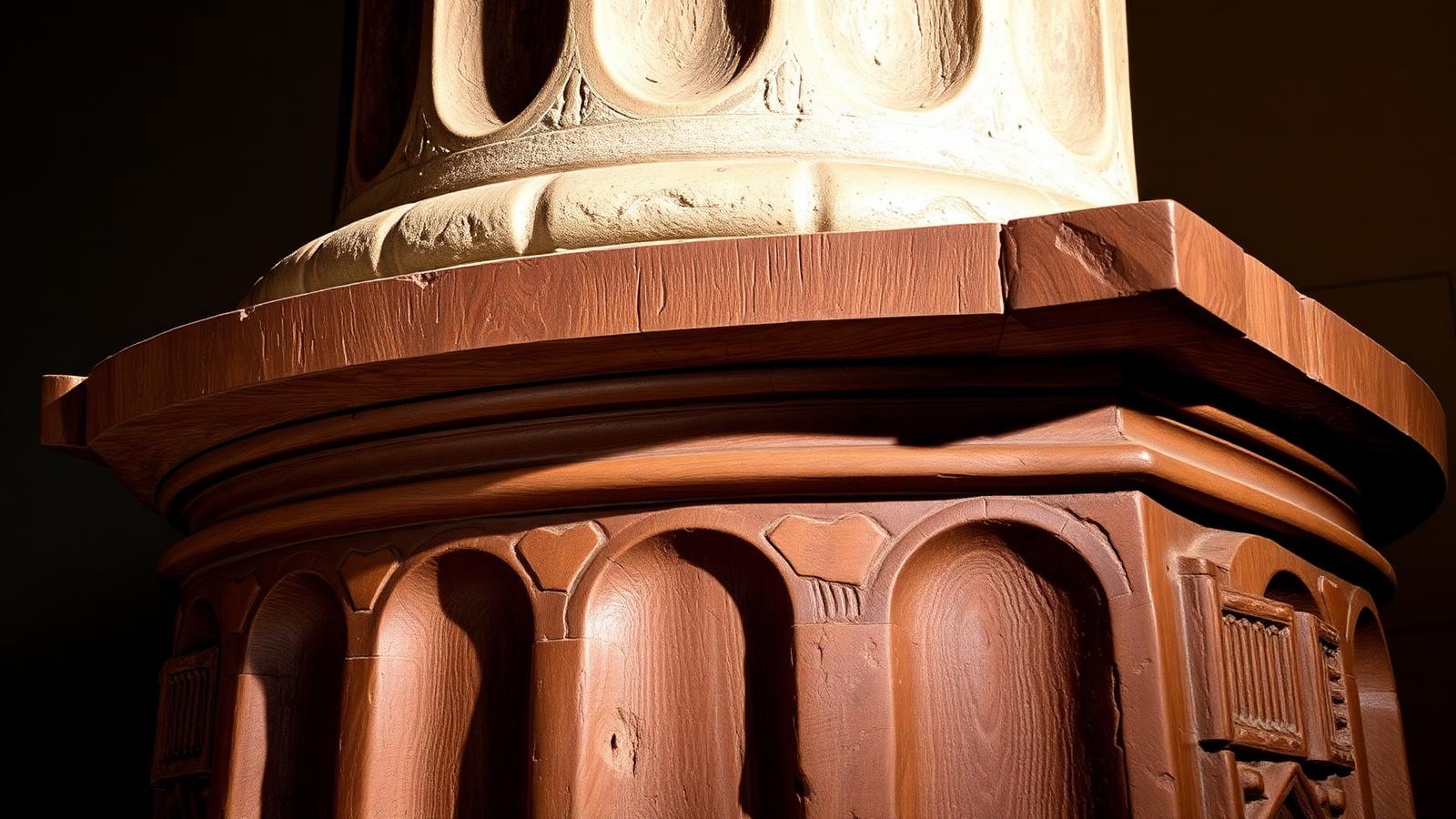
Four Pillars
The Framework
Engaging the contemporary world through the lens of timeless theology. Four commitments that carry the weight of everything else we publish.
Read the Order
These four are not four topics of equal weight sitting side by side. They are a sequence, and the sequence matters more than any one of them.
Everything begins outside this list, with the gospel of Jesus Christ — that God made the world, that man rebelled, that Christ died and rose to redeem sinners. Truth comes first among the pillars because it is the immediate consequence of that gospel: if Christ is risen, reality has a fixed shape and we are obliged to it. Beauty follows, because a world with an Author has glory in it. Politics follows, because men who see reality rightly must govern justly. Culture comes last, because culture is simply what a reordered people builds when nobody is making them.
Run the sequence backward and you get cultural Christianity — a people defending an inheritance whose source they no longer believe. We are not interested in that. Start with the gospel, then read what follows.
Truth
"Thy word is a lamp unto my feet, and a light unto my path."
Psalm 119:105
Truth is not a preference, a mood, or the settled opinion of the current generation. It is the fixed character of reality as God made it, and it does not bend for us. The modern age has spent a century insisting that every man is entitled to his own truth, and it has produced a people who can no longer agree on what a man is.
We hold that Scripture speaks with authority on the questions that matter most — the nature of God, the nature of man, the origin of the world, and the end toward which all things move. Where it speaks, argument ends. Where it is silent, reason and tradition guide us, and they do so best when they remain in submission to what has been revealed.
This is not intellectual cowardice. It is the opposite. To submit to a truth outside yourself is the hardest thing a modern man can do, and it is the beginning of every other virtue.
Truth stands first here because everything downstream depends on it. A culture is only ever the visible shape of what a people actually believes is real. Change what men hold to be true about God, and within two generations you will see it in their architecture, their laws, their music, and their marriages. We do not engage culture as a separate project from truth; culture is what truth looks like after it has been believed for a while.
Beauty
"One thing have I desired of the LORD... to behold the beauty of the LORD."
Psalm 27:4
Beauty is not decoration. It is argument. A cathedral makes a case for the transcendent that no pamphlet can match, and a building that scorns beauty makes a case of its own — that man is an accident, that permanence is a lie, that nothing here is worth the labor of ornament.
The Christian West built for centuries as though the world were charged with glory, because it believed the world was. Its music, its architecture, its poetry, and its painting were acts of worship rendered in stone and sound. That inheritance was not incidental to the faith; it was the faith made visible.
We take beauty seriously because we take God seriously. A man who cannot recognize glory in a Bach chorale or a Gothic vault has trained his eye to miss it in the face of his own children.
Politics
"Seek the peace of the city whither I have caused you to be carried away."
Jeremiah 29:7
Politics is stewardship, not salvation. No election redeems a nation and no statute regenerates a heart. But the man who therefore withdraws from public life has confused two errors for one virtue — he has traded the idolatry of politics for the negligence of it.
Scripture assumes that men will govern, judge, legislate, and go to war, and it holds them accountable for how. Justice, mercy, honest weights, and protection of the weak are not partisan positions. They are the terms on which God evaluates a people.
We engage the public square with a paternal spirit: not shrill, not frightened, and not naive. We seek the welfare of the city while remembering that our citizenship is finally elsewhere.
Culture
"Remove not the ancient landmark, which thy fathers have set."
Proverbs 22:28
Culture is what a people does when nobody is making them. It is the table on Sunday, the songs sung at funerals, the trades passed from father to son, the names given to children. It is downstream of worship, and it is upstream of everything else.
The West did not become the West by accident. Two thousand years of Christian conviction shaped its law, its universities, its hospitals, its concept of the person, and its instinct that the weak have a claim on the strong. Those fruits are now being eaten by men who have cut down the tree.
Our work is not nostalgia. It is cultivation. We are interested in what men can build in their own households and towns — traditions durable enough that grandchildren inherit them without being told to.
Culture comes last in this framework on purpose. It is the harvest, never the seed. No amount of cultural recovery can substitute for the gospel, and a Christendom without Christ is a museum. The order runs one direction only: Christ is preached, men believe, believing men are reordered, and reordered men build. Reverse it and you get a heritage society — well-dressed, well-read, and dead.
See It Worked Out
Every essay, episode, and dispatch we publish argues from one of these four pillars. Start with the writing.
Read the Essays